
Skill Up or Stand Still: The Best Online Platforms for Career-Defining Courses

The UK job market is shifting fast. According to the CIPD, employer spending on training
fell by 27% over the past decade — from £4,095 per trainee in 2011 to just £2,971 in 2022.
That gap increasingly falls on workers themselves to fill. That is why professionals
ranging from HR managers to those pursuing a passive house designer qualification are
turning to dedicated, reliable, and accessible specialist course providers to gain the
credentials that actually move careers forward.
Online learning has stepped into that space, but not all platforms are equal. The
difference between a course that strengthens your CV and one that sits forgotten on
your profile often comes down to one thing: choosing the right platform for the right goal
from the start.
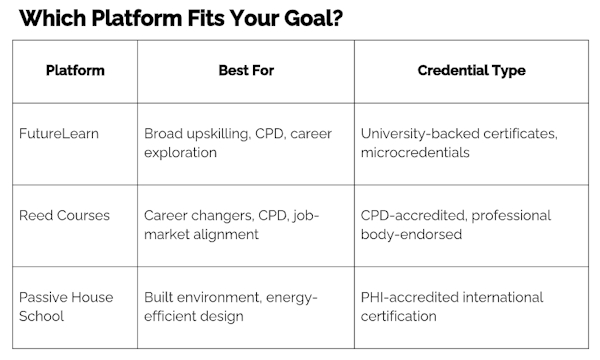
FutureLearn: British Roots, Genuine Academic Weight
For UK learners, FutureLearn offers a distinctly British academic heritage that sets it
apart from many global platforms. Founded in 2012 by The Open University, it launched
with a group of established UK university partners, including King’s College London, the
University of Bristol, and Cardiff University. That background gives many of its courses
and certificates clear institutional credibility.
FutureLearn’s flexible structure also suits working adults: short courses often run from
around two to ten weeks and typically require only a few hours of study per week, while
microcredentials and postgraduate certificates provide more substantial options for
those ready to take their learning further. Across subjects such as digital skills,
healthcare, education, business, and sustainability, it offers a broad and practical starting
point for both career changers and professionals looking to deepen existing expertise.
Reed Courses: The Platform Built Around the British Job Market
Reed Courses occupies a unique position that no other platform can claim: it sits directly
inside one of the UK's largest job boards. With over 155,000 courses from around 1,400
learning providers and nearly 11 million course seekers visiting annually, it functions as
both a training marketplace and a career tool in a single place. Reed’s career advice
section provides guidance on CVs, salary expectations, and job applications, helping
learners connect training with employment opportunities.
Its breadth spans accounting, HR, construction, IT, health and social care, and beyond,
with many courses CPD-accredited or endorsed by recognised professional bodies.
Passive House School: When the Industry Standard Is the Only Standard that Counts
General platforms have a ceiling. In sectors where employers hire against precise,
verified competency frameworks, a broadly recognised credential is not enough. You
need the credentials that the industry itself has defined.
This is particularly true in the built environment, where the UK's net zero commitments
are driving genuine demand for energy-efficient construction expertise. For architects,
engineers, and building professionals, finding a dedicated passive house designer
course provider that holds accreditation from the Passive House Institute — the global
standard-setter in high-performance building design — is essential, and Passive House
School delivers exactly that.
It offers internationally recognised certification through structured, practitioner-led
online training. For anyone mapping out their next professional move, a solid career
guide specific to the built environment will consistently point towards PHI-accredited
credentials as the benchmark worth pursuing. The qualification travels: it is specified by
clients, recognised across Europe, and directly tied to a growing pipeline of certified
building projects in the UK.

Choosing where to learn is not a minor administrative decision — it shapes how
employers perceive you, which roles you can credibly apply for, and how quickly you
can move once you decide to act. A certificate from a platform nobody in your industry
recognises does very little. A credential tied to an institution, professional body, or
international standard that hiring managers actively look for is an entirely different
proposition.